

The Invisible $50,000 Burr: How Microscopic Edge Defects Silently Destroy Margins in Aluminium Processing
Artificial intelligence meets microscopic optics — the case for 10 µm/pixel edge inspection on every slitting and rolling line
3/25/20264 min read
The Invisible $50,000 Burr: How Microscopic Edge Defects Silently Destroy Margins in Aluminium Processing
Artificial intelligence meets microscopic optics — the case for 10 µm/pixel edge inspection on every slitting and rolling line
By SpechtLab Editorial
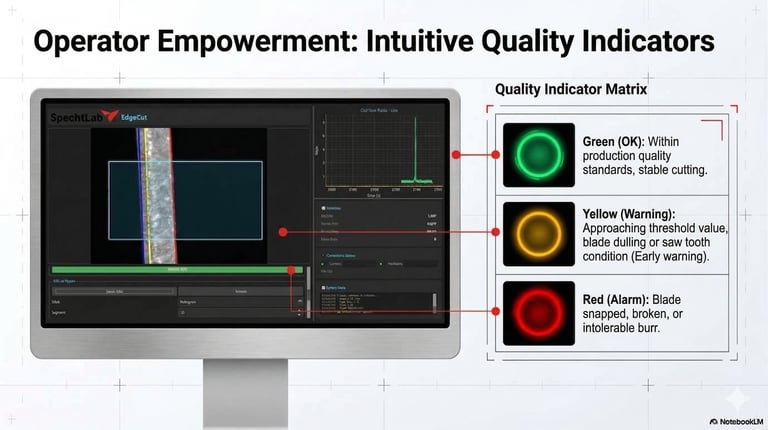
The burr is invisible to the naked eye. At 18 micrometres high — less than a fifth of the diameter of a human hair — it leaves no trace during visual inspection, passes every manual quality gate, and ships to the customer. Then it fails. In a beverage can, it pierces the lubricant film during cupping, causing a split that shuts down the customer's line for four hours. In an EV battery cell, it penetrates the separator under charge cycling, igniting a thermal runaway event. The warranty claim arrives weeks later.
This is the economics of microscopic edge quality: the defect that escapes detection costs two to three orders of magnitude more than the defect caught at source. SpechtLab EdgeCut Vision AI was built to close that gap — permanently.
Why Traditional Edge Inspection Fails
Conventional camera-based edge inspection systems operate at 50–100 µm/pixel resolution — sufficient to detect visible burrs but blind to the sub-30 µm defects that drive the most expensive downstream failures. They also rely on fixed-threshold image processing that cannot adapt to the material-dependent edge morphology of different alloys, tempers, and thicknesses.
Manual sampling — the fallback in most plants — is statistically inadequate. A trained inspector examining 1 metre in 60 seconds provides coverage of perhaps 0.1% of a 600-metre coil. The remaining 99.9% ships on the basis of assumption.
The result is a quality gap that has been tolerated for decades because no affordable 100% inspection solution existed. That constraint no longer applies.
EdgeCut Vision AI: Technology Architecture
EdgeCut Vision AI deploys high-magnification telecentric optical assemblies above both strip edges, achieving 10–30 µm/pixel resolution across the full edge depth. The illumination — coaxial LED or structured light, depending on the detection target — is synchronised to the camera to eliminate motion blur at line speeds up to 350 m/min.
The AI inference engine, running on an embedded GPU module, processes each frame with a latency of less than 10 milliseconds. It classifies detected anomalies into six categories: burr height, micro-crack depth, edge waviness amplitude, delamination extent, rollover profile, and surface particle contamination. Each classification is associated with a measurement value — not merely a binary pass/fail — enabling statistical process control rather than just defect flagging.
The system generates a spatial defect map for the entire coil edge: every detected anomaly is registered with its position in metres from the coil lead end, enabling downstream operators to locate and reinspect any flagged zone in seconds.
Industry Applications Driving Adoption
Automotive aluminium body sheet represents the highest-volume application. Tier-1 suppliers slitting 5xxx- and 6xxx-series alloys for door skins, hood panels and body-side reinforcements face zero-tolerance edge quality requirements from OEMs. EdgeCut Vision AI generates a per-coil digital edge passport that satisfies IATF 16949 traceability requirements and eliminates the manual inspection burden that adds 45–90 minutes to every coil release cycle.
Beverage can stock is the application where payback is most immediate. Can-body stock slit to target width must have burr heights below 20 µm across 100% of the slit edge to avoid cupping-press failures. A single line stoppage at a high-speed can plant costs $8,000–$15,000; a slit-induced press seizure causing tooling damage can reach $80,000. Plants running EdgeCut Vision AI report elimination of slitting-related cupping failures within one production month.
EV battery electrode foil — copper anode current collector and aluminium cathode current collector — represents the fastest-growing application. Electrode foil slit to cell width must be burr-free to prevent separator puncture. The tolerance is 30 µm maximum burr height; the consequence of exceedance is a battery fire. No manual or conventional vision system can guarantee 100% compliance at production volumes; EdgeCut Vision AI can.
From Defect Detection to Digital Product Passport
EdgeCut Vision AI is designed as a node in the SpechtLab DataPool ecosystem. Every edge measurement is automatically linked to the coil identity (via OCR or barcode), stored in the DataPool quality database, and made available as a Digital Product Passport — a structured quality record that travels with the material through the supply chain.
This capability is increasingly mandatory. The EU Battery Regulation (Regulation 2023/1542) requires material traceability for EV battery components; the automotive sector's shift toward IATF 16949 digital quality records will extend similar requirements to body-sheet supply chains. Processors who implement EdgeCut Vision AI today are building the traceability infrastructure their customers will require tomorrow.
ROI: The Numbers Behind the Investment
A mid-size aluminium slitting centre processing 80,000 tonnes per year with a 0.2% slitting-related customer claim rate faces approximately €500,000 in annual claim exposure. EdgeCut Vision AI, installed on two slitting lines, typically reduces slitting-related claims by 85–95% in the first year, delivering €425,000–€475,000 in annual claim savings against a capital investment that is recovered in under 14 months in most installations.
Additional savings accrue from blade-wear trending: EdgeCut Vision AI's per-coil burr statistics enable predictive blade-change scheduling, typically reducing emergency blade-change stoppages by 60% and extending average blade set life by 15–25%.
Frequently Asked Questions
What alloys and tempers can EdgeCut Vision AI inspect?
The system has been validated on 1xxx through 8xxx series aluminium alloys, all common copper alloys, and stainless steel strip. The AI model is trained per material family and can be reconfigured at the operator panel for each production order.
Can the system inspect both edges simultaneously?
Yes. The standard configuration uses two independent camera-optical assemblies, one per edge, operating synchronously. Both edges are reported in the same defect map.
How long does installation take?
A standard single-line installation requires one production shift for mechanical mounting and a further half shift for system commissioning and baseline model calibration. No changes to existing camera infrastructure are required.
Does the AI model require retraining for new products?
No. The base model covers the common defect taxonomy across aluminium alloys. Product-specific threshold profiles are configured from the order management system without model retraining.
The burr that costs €0.002 to catch at the slitter costs €500 to manage as a customer claim. EdgeCut Vision AI eliminates the gap between those two numbers. Contact SpechtLab to arrange a demonstration on your production line or to request sample detection results from your own coil material.
Ready to see SpechtLab technology on your production line?
Contact us at www.spechtlab.com · info@spechtlab.com
AI - Powered Measuring Systems
info@spechtlab.com
© 2024. All rights reserved.