

Stroboscopic LED Lighting for High-Speed Machine Vision Inspection | SpechtLab BL Series
At 2,000+ m/min, conventional LED lights produce blurred images and miss critical surface defects. Discover how SpechtLab's BL Series stroboscopic LED technology eliminates motion blur and achieves 100% surface coverage in steel, aluminium, and packaging lines.
3/31/20264 min read
Why Your High-Speed Production Line Is Bleeding Money to Motion Blur
A deep dive into stroboscopic LED technology — and why the world's fastest rolling mills now refuse to run without it
By SpechtLab Editorial
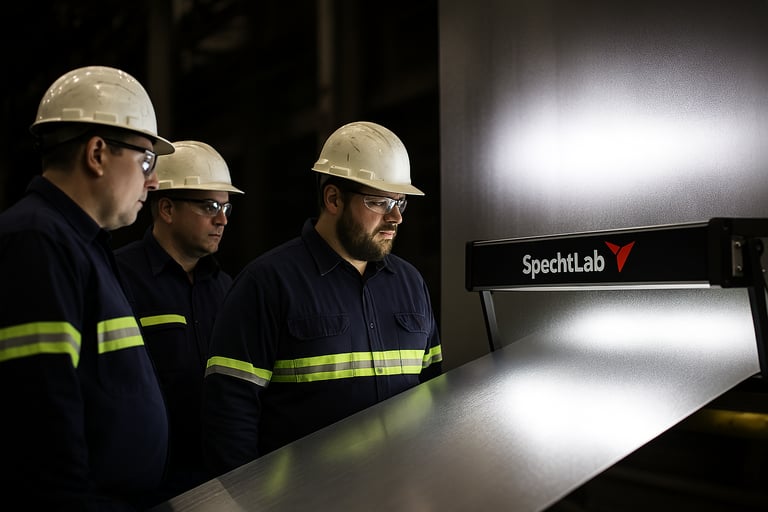
At 2,000 metres per minute, a strip of aluminium travels the length of a football field every 18 seconds. For the machine-vision cameras mounted above it, that velocity is not speed — it is chaos. Conventional LED ring lights, however bright, deliver continuous illumination that smears every image into an indistinguishable grey blur. The defect may be real. The camera simply cannot see it.
The invisible losses that follow — undetected scratches shipped to automotive OEMs, pinholes in battery foil causing field failures, roll marks on packaging stock triggering customer returns — represent a slow, silent erosion of margin that most plant managers never fully measure. SpechtLab's BL Series Stroboscopic LED Lighting system was engineered to end that erosion.
The Physics of Motion Blur in Industrial Inspection
Machine-vision cameras capture images by accumulating photons over an exposure window. At 1,500 m/min with a conventional 10 ms exposure, a point on the strip surface moves 250 mm during a single frame — effectively smearing any feature smaller than a quarter of a metre into noise. Even reducing exposure to 100 µs still produces 2.5 mm of motion blur at that speed, far exceeding the 0.05–0.1 mm detection threshold required for automotive-grade surface inspection.
The only solution is to eliminate the exposure time problem at the light source. A strobe flash of 1–5 µs duration limits apparent motion to 0.025–0.125 mm regardless of line speed, cleanly resolving features an order of magnitude smaller than any continuous-illumination system can achieve.
How BL Series Stroboscopic Technology Works
The BL Series operates on the principle of synchronised burst illumination. An encoder or camera trigger signal fires the LED array in sub-microsecond pulses precisely timed to coincide with the camera's integration window. The strip effectively stands still in the image — frozen by photons rather than mechanics.
Peak luminous intensity during the flash can reach 200× the continuous-mode rating of the same LED array, because thermal limits apply to average power, not instantaneous power. This means the BL Series delivers dramatically brighter illumination than any continuous-light competitor of equivalent size, translating directly into higher signal-to-noise ratios and sharper defect images.
Key specifications: pulse width 1–10 µs, repetition frequency up to 100 kHz, wavelength options from 365 nm UV to 940 nm near-infrared, IP65 sealed housing, and trigger interfaces compatible with all major industrial camera standards.
Where BL Series Delivers the Highest Return
Steel and aluminium cold rolling mills running at 1,200–2,000 m/min represent the primary application. Surface scratches, roll marks, and oxidation patches that conventional systems miss at these speeds are routinely detected by BL-equipped vision lines, with false-positive rates below 0.1% thanks to the high contrast images the system produces.
Flexible packaging converters and label printers running web inspection at 300–500 m/min report elimination of colour-register errors and pinholes reaching customer sites after BL Series installation. The system also solves a persistent problem in high-speed printing: ambient light interference from overhead fluorescents, which strobed illumination completely suppresses by design.
Lithium-ion battery electrode foil (6–20 µm aluminium or copper) presents perhaps the most demanding case. Pinholes as small as 0.05 mm² must be detected to prevent internal short circuits in finished cells. BL Series, combined with a telecentric line-scan camera, delivers 100% pinhole coverage at coating speeds exceeding 80 m/min — a capability that no continuous LED system can match.
The Business Case: What Motion Blur Is Costing You Right Now
A mid-size aluminium rolling mill shipping 120,000 tonnes per year to automotive customers faces typical customer-claim rates of 0.15–0.3% on surface quality. At an average claim value of €800 per tonne, that represents €144,000–€288,000 in annual warranty exposure attributable to undetected surface defects — not including the reputational cost of repeat claims.
Plants that have retrofitted BL Series illumination onto existing camera lines report a 60–80% reduction in customer surface claims within the first production quarter, with typical payback periods of 4–9 months. The system requires no new camera hardware — the BL Series is designed as a drop-in replacement for existing light sources, with the strobe controller unit fitting in a standard DIN-rail cabinet.
Beyond defect reduction, the high-contrast images BL Series produces significantly reduce the compute load on vision-system processors. AI defect-classification models trained on stroboscopically lit images achieve 94–97% classification accuracy versus 70–82% on continuous-light images of the same material, reducing the false-call rate that generates expensive manual review workflows.
Integration and Deployment
BL Series integrates with all standard machine-vision ecosystems. The trigger input accepts TTL, RS-422, and open-collector signals; intensity is adjustable via 0–10 V analogue or digital control; and the system supports both free-run and triggered modes. Firmware updates are delivered over Ethernet, and the strobe controller exposes a REST API for integration into plant-level dashboards.
Installation typically requires one shift. The BL Series housing mounts on standard C-profile or custom brackets, and the enclosure's IP65 rating allows direct installation above wet sections of galvanising or cooling lines without additional protection. Mean time between failures exceeds 100,000 operating hours at rated conditions.
Frequently Asked Questions
Can BL Series work with our existing cameras?
Yes. The system is camera-agnostic and works with any camera that accepts an external exposure trigger, including GigE Vision, USB3 Vision, Camera Link, and CoaXPress models from all major manufacturers.
Does high-frequency strobing cause visual fatigue for nearby operators?
No. The duty cycle and pulse energy are selected so that the integrated visual effect is equivalent to standard factory lighting. The system is CE marked and complies with EN 62471 photobiological safety standards.
What happens during a trigger loss event?
The BL Series strobe controller detects trigger loss within 10 ms and switches to a safe continuous low-intensity fallback mode, ensuring the camera line continues to image without uncontrolled dark frames.
Is the system suitable for colour inspection?
Yes. BL Series is available in white-light (broad spectrum), R/G/B individual channel, and UV variants. Colour camera installations typically use white strobe; dedicated colour-defect applications may use multi-spectral configurations.
Motion blur is not an engineering inconvenience — it is a revenue leak. The BL Series was designed with one objective: to remove the illumination bottleneck from high-speed industrial inspection so that every defect on every metre of production is visible, detectable, and actionable. Contact SpechtLab to arrange a line-speed demonstration or request a sample image set from your own production material.
Ready to see SpechtLab technology on your production line?
Contact us at www.spechtlab.com · info@spechtlab.com
AI - Powered Measuring Systems
info@spechtlab.com
© 2024. All rights reserved.