

Cameras in Hell: How Liquid-Cooled Enclosures Bring Machine Vision to 400°C Process Environments
Liquid-Cooled Camera Enclosures for Extreme Industrial Environments | SpechtLab LC Series
3/25/20264 min read
Cameras in Hell: How Liquid-Cooled Enclosures Bring Machine Vision to 400°C Process Environments
Why the most profitable machine-vision upgrades are in the places where standard cameras cannot survive
By SpechtLab Editorial
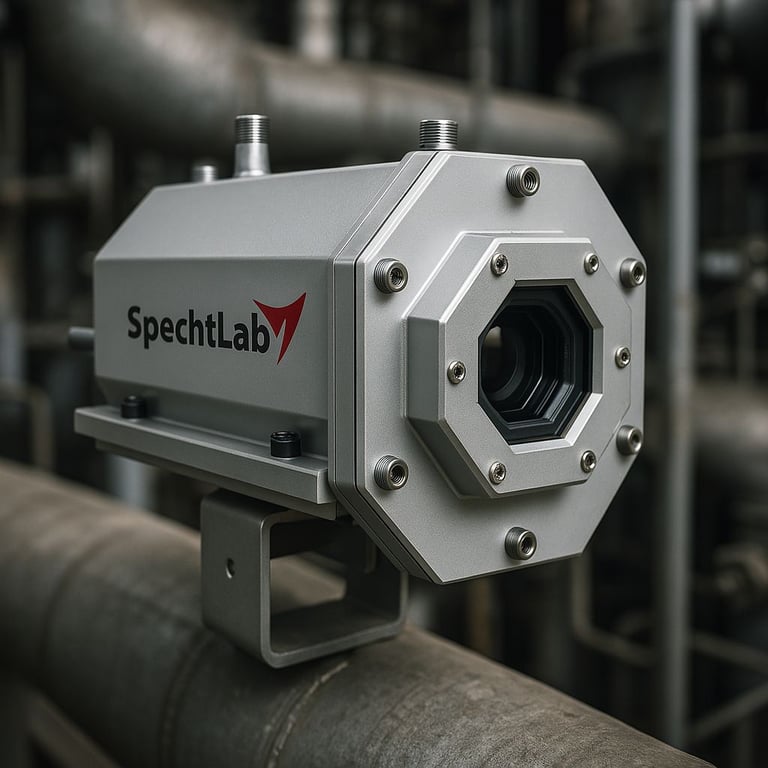
There are places in a steel plant where no camera has any business being. The continuous caster secondary cooling zone — 350°C ambient, steam clouds, water scale, and radiant heat intense enough to ignite conventional wiring — is one of them. The runout table of a hot aluminium rolling mill is another. So is the working zone of a 5,000-tonne forge press. These are environments that destroy standard electronics in hours.
They are also, without exception, the locations where machine-vision inspection would deliver the highest process value. The paradox has persisted for decades: the harshest zones of heavy industry are both the most critical for inspection and the most hostile to the sensors needed to perform it. SpechtLab LC Series liquid-cooled camera enclosures were engineered to resolve that paradox.
The Engineering Challenge: Heat, Contamination, and Continuous Duty
Industrial machine-vision cameras typically carry operating temperature ratings of 0–50°C. Beyond that, thermal throttling degrades image quality; beyond 65–70°C, permanent failure is typical. In a continuous caster environment, the ambient temperature alone exceeds the camera's survival limit by a factor of five to seven.
Passive enclosures — insulated boxes with no active cooling — can buffer temperature transients but cannot provide continuous thermal protection in steady-state high-temperature environments. They also fail to address the equally destructive challenge of contamination: fine steel scale and metallic dust infiltrate conventional enclosures through thermal cycling gaps, contaminating lenses and electronics within weeks.
The solution requires active thermal management, contamination control, and a structural material that maintains dimensional stability and sealing integrity at elevated temperatures across thousands of thermal cycles.
LC Series: Active Thermal Architecture
The LC Series enclosure body is machined from AISI 310 stainless steel — selected for its combined oxidation resistance, high-temperature strength, and compatibility with water cooling circuits operating at 50–60°C coolant temperature. The water-cooled variant circulates plant cooling water through an internal jacket that maintains the camera cavity below 45°C regardless of ambient conditions up to 400°C.
The air-cooled variant uses a Ranque-Hilsch vortex tube to generate a stream of compressed-air-cooled air, providing protection to 80°C ambient without requiring a water connection — critical for applications where water leaks pose a contamination or safety risk, such as aluminium rolling runout tables.
Both variants incorporate a positive-pressure air purge circuit that continuously flows clean filtered air across the optical window at controlled velocity, preventing scale, dust, and condensation from reaching the lens. The optical window itself is available in borosilicate glass, sapphire, or anti-reflective zinc selenide depending on the wavelength and abrasion requirements of the application.
Applications: Where LC Series Creates the Most Value
Continuous casting strand surface inspection is the flagship application. Vision cameras installed in LC Series enclosures above the strand in the secondary cooling zone detect longitudinal cracks, transverse cracks, and surface depressions in real time at cast speeds of 0.5–2.0 m/min. The detection system feeds directly into the caster control room, enabling operators to adjust cooling water distribution before crack propagation reaches critical depth.
Hot rolling mill bar and strip tracking requires cameras to operate in 200–300°C ambient with regular exposure to mill scale bursts. LC Series enclosures allow plants to deploy standard GigE Vision cameras in these zones without custom high-temperature camera hardware, reducing both capital cost and spare-parts inventory complexity.
Forge press die alignment monitoring represents a high-value niche application. A mis-stroke on a large forging press — where the upper and lower dies contact without a workpiece correctly positioned — can destroy tooling valued at €20,000–€100,000 per set. LC Series enclosures enable cameras to verify die and workpiece position from inside the press working zone, preventing mis-stroke events with a detection cycle of under 50 ms.
Operational and Commercial Benefits
The single most important commercial attribute of the LC Series is continuous duty cycle. Unlike conventional camera installations in hot environments — which typically require 20–30 minute cooldown periods every 2–4 hours — LC Series installations operate without scheduled thermal interruptions. In continuous casting, where the strand cannot stop, this is not a convenience; it is a prerequisite.
Maintenance intervals are equally important. The LC Series is designed for annual preventive maintenance rather than the weekly or monthly cleaning cycles that conventional hot-zone camera installations require. The stainless housing resists corrosion from water spray and acidic scale washdown, and the optical window air blast eliminates manual lens cleaning entirely in most applications.
Capital cost comparison also favours the LC Series in the medium term. A purpose-built high-temperature camera capable of operating at 80°C ambient carries a list price 8–12× higher than a standard GigE camera. Two LC Series enclosures protecting standard cameras cost less than one custom high-temperature unit and provide redundancy, field-replaceable optics, and compatibility with whatever camera technology the plant standardises on.
Frequently Asked Questions
What camera models are compatible?
Any camera that fits within the 120 × 80 mm internal cavity is compatible, including models from Basler, Teledyne FLIR, Cognex, Sony, IDS, and all other major manufacturers. C-mount and CS-mount lens adapters are standard; F-mount adapters are available.
How is the cooling water connected?
The cooling circuit uses standard 8 mm push-fit pneumatic tube fittings compatible with plant copper and stainless cooling lines. The circuit is a once-through or recirculating configuration depending on plant cooling infrastructure.
Can LC Series enclosures be used in ATEX / explosive atmospheres?
The standard unit is not ATEX certified. ATEX-rated variants are available for aluminium dust and hydrocarbon atmosphere classifications; consult SpechtLab for specification.
What is the lead time for a custom optical window specification?
Standard borosilicate and anti-reflective windows are ex-stock. Sapphire windows carry a 4–6 week lead time for custom sizes.
The cost of not inspecting a continuous caster strand is a missed crack that reaches critical depth, causing a breakout — an event that shuts the caster for 24–72 hours and can damage equipment worth millions. The LC Series makes continuous-duty inspection in these environments economically and technically feasible. Contact SpechtLab to discuss your specific thermal environment and inspection requirements.
Ready to see SpechtLab technology on your production line?
Contact us at www.spechtlab.com · info@spechtlab.com
AI - Powered Measuring Systems
info@spechtlab.com
© 2024. All rights reserved.